Clever Gambling in Monaco
Theme: Clever Gambling in Monaco — this week introduces Monte Carlo Localization (MCL), where probability meets robotics. Robots “gamble” with particles to find out where they really are.
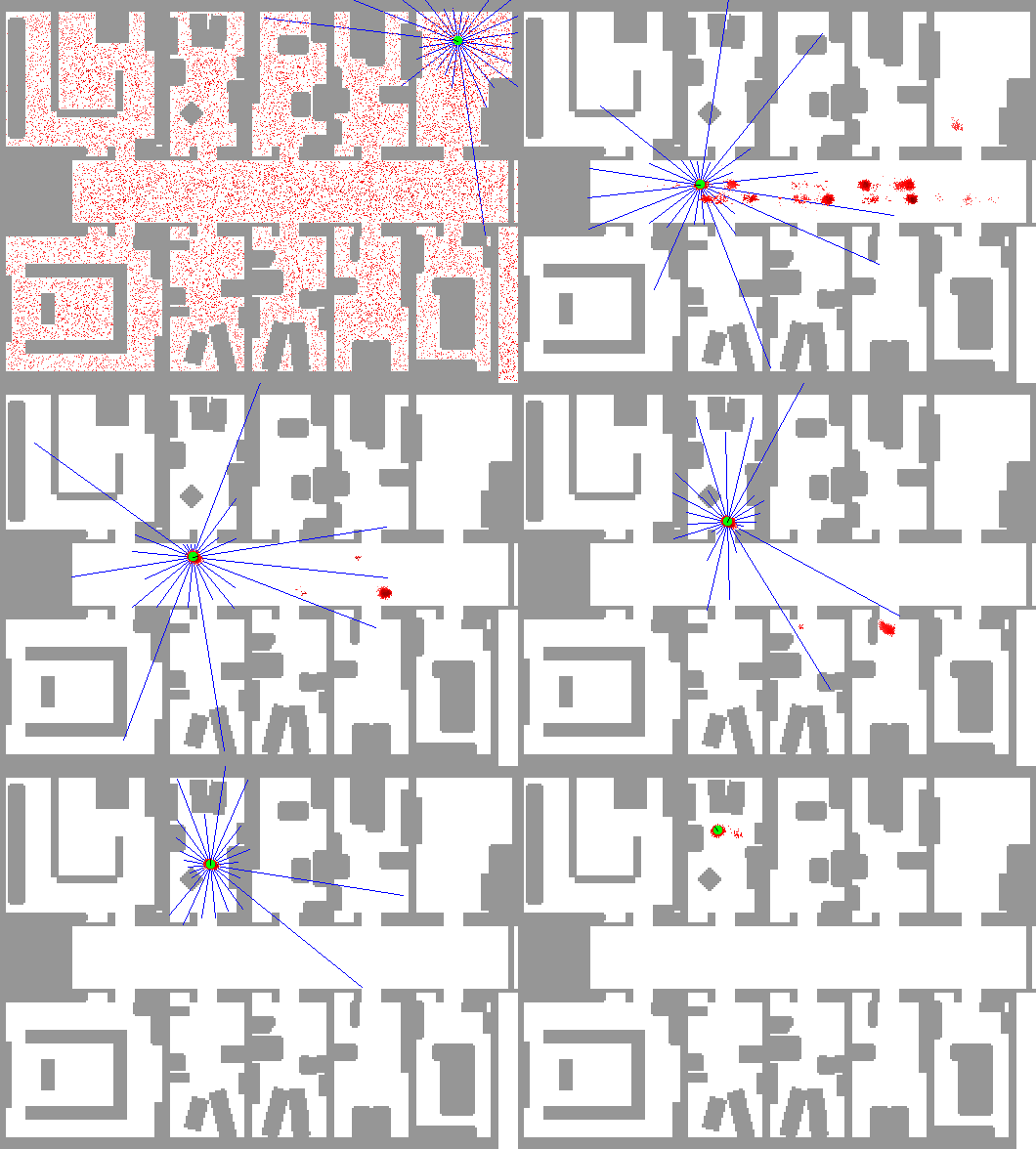
Focus
Understand the principles of Monte Carlo Localization (MCL).
Learn how particle filters estimate a robot’s pose.
Explore the connection between probability, motion models, and sensor models.
Implement MCL in Python and compare it with ROS 2’s AMCL package.
Learning Flow
Theory - The localization problem: “Where am I?” - Monte Carlo method: random sampling for probabilistic estimation. - Particle filters:
Initialization
Motion update
Sensor update
Resampling
Why it’s called Monte Carlo (link to casino roulette analogy).
Practical / Code - Implement a custom Python MCL with NumPy:
Initialize particles in free space
Propagate with a noisy motion model
Weight particles based on sensor likelihood
Resample to focus on probable poses
Visualize the particle cloud converging on the robot’s location.
ROS 2 Integration - Use Nav2 AMCL for real-world localization. - Launch AMCL with a 2D occupancy map. - Visualize particle clouds in RViz2. - Compare results from your custom Python implementation.
Assignment - Write a Python implementation of MCL. - Run Nav2 AMCL with TurtleBot3 (or another robot) in Gazebo. - Push results, code, and a short README to GitHub:
Explanation of MCL
Your implementation
Screenshots of ROS 2 AMCL in action
Takeaway
By the end of this week, students will understand how robots use probability to localize. They will see how random “gambling” with particles transforms into accurate localization, both in a custom Python implementation and in ROS 2 AMCL.
This week brings to life the connection between probability theory, code, and real-world robotics — demonstrating that sometimes, gambling is clever.